


Hemlock Woolly Adelgid Threatens Our Natural Areas
In order to effectively manage Cornell Botanic Gardens’ Natural Areas, we are continually on the lookout for potential threats to their integrity. For several years, we have kept a close eye on the spread of the hemlock woolly adelgid, a destructive pest that has been steadily encroaching on the Finger Lakes region. In January 2009 the insect was found on eastern hemlock (Tsuga canadensis) trees in Cascadilla Gorge and the forest surrounding Beebe Lake, two of Cornell Botanic Gardens’ premier on-campus Natural Areas. Subsequent volunteer and staff monitoring efforts have discovered additional infestations in Cornell Botanic Gardens' Fall Creek Gorge, Fall Creek South, Coy Glen, Warren Woods, Edwards Lake Cliffs, Fisher Old Growth Forest, Carter Creek, Steep Hollow Creek, Lick Brook, Renwick Slope, and Ringwood Ponds Natural Areas.
Learn more about our volunteer monitoring programs here.
How is the hemlock woolly adelgid threatening the health of our forest ecosystems?
Native to Japan, the hemlock woolly adelgid (Adelges tsugae) is an aggressive insect pest that feeds on the sap of young hemlock twigs. Eventually needles yellow and drop, branches die, and trees succumb in about four to ten years. The insect poses a serious threat to both Carolina hemlock (Tsuga caroliniana) and eastern hemlocks, causing nearly 100% mortality in infested trees. It has decimated populations from North Carolina to eastern Pennsylvania and southern New England. For a current New York State distribution map, click here.
Eastern hemlocks are an important part of our forest ecosystems, and their disappearance causes negative environmental changes for many plants and animals. Hemlocks provide shelter for ruffed grouse, deer, and a variety of small mammals and birds. Their shade provides temperature regulation for cold-water loving amphibians, fish, and invertebrates. Growing in association with hemlocks, relict plants (species which require cool and moist climates found further north) are also threatened.
What is Cornell Botanic Gardens doing to address the threat of the hemlock woolly adelgid?
Controlling the spread of the hemlock woolly adelgid depends on increased public awareness and involvement. An essential strategy involves early detection, and is most effective when the community works together.
Cornell Botanic Gardens, in partnership with Cornell's Department of Natural Resources periodically provides late winter workshops to train volunteers how to identify and report new hemlock woolly adelgid infestations within the Ithaca area. To view last year's workshop, click here. If you are interested in volunteering to report area infestations, contact our Natural Areas staff.
Cornell Botanic Gardens continues working towards the control of hemlock woolly adelgids by treating infestations and by providing the use of our Natural Areas for research into more effective control. In October, 2009, researchers Mark Whitmore from Cornell University and Dave Mausel from the University of Massachusetts-Amherst introduced a biocontrol agent as part of a 10 year study sponsored by the US Forest Service. Three hundred individuals of Laricobius nigrinus, a predatory beetle native to the northwestern united states, were released to study the ability of a new inland biotype to successfully overwinter and feed on all life stages of hemlock wooly adelgids. Read more about this study below:
Cornell Chronicle Story.
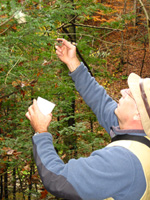
Cornell Botanic Gardens Natural Areas Program also support academic collaborations with students. In 2014, students from the Biology Service Leaders Student Organizatoin evaluated the health of trees treated with a variety of pesticide control applications, including imidacloprid soil injections (Criterion 2F; 21.3%), time release tablets (Coretect; 20%), and trunk injections (IMA-jet; 5%), documenting no significant differences amoung treatments.
In another collaborative effort with Whitmore, Cornell Botanic Gardens is caring for about 40 introduced hemlock trees, sourced from a potentially adelgid-resistant stand discovered 10 years ago in New Jersey. Whitmore and other researchers are attempting to discern if the apparent resistance is due to a unique hemlock adaptation or unique conditions present in the trees’ original location.
We are also actively treating hemlock trees within several natural areas as part of our broader conservation strategy, aimed at conserving the genetic diversity in hemlocks across representative and spatially distributed natural community types. Our natural areas holdings contain over 700 acres of hemlock forests, making treatment for all sites and all trees unrealistic. Therefore, we developed a process to evaluate the conservation and educational value of the hemlock stands to guide our detection and control efforts.
For those sites where we have made a long-term committement to preserve hemlocks, we have been making significant progress in controlling HWA. Since 2009, Cornell Botanic Gardens staff have treated a total of 1200 hemlock trees with imidacloprid pesticide through soil injection, trunk injection, and time release tablets. Beginning in 2014, bark application of imidacloprid was permitted in New York State, adding adding a new alternative for bark application alone or in conjunction with dinotefuran.
Learn more
Click here to view an educational film about the efforts to control hemlock woolly adelgid produced as part of the NYS Hemlock Initiative.
What can you do?
- Report hemlock woolly adelgid sightings here.
- Volunteer to report hemlock woolly adelgid infestations.
- Report heavily HWA-infested hemlock stands that appear healthy and potentially genetically resistant to HWA.
- Join the hemlock woolly adelgid e-list serv.
- Support Cornell Botanic Gardens' efforts by making a donation here.
- Learn more about the hemlock woolly adelgid's biology, identification, and control here.
Have questions? Visit our Frequently Asked Questions page, or Contact the Tompkins County Cooperative Extension at (607) 272-2292.
Image and Map Gallery
View infested eastern hemlock.
View adult and eggs.
View crawler stage.
Cornell Botanic Gardens Natural Areas in the News
Read the March 12 Cornell Chronicle Online story, "Devastating invasive pest threatens hemlock trees in region."